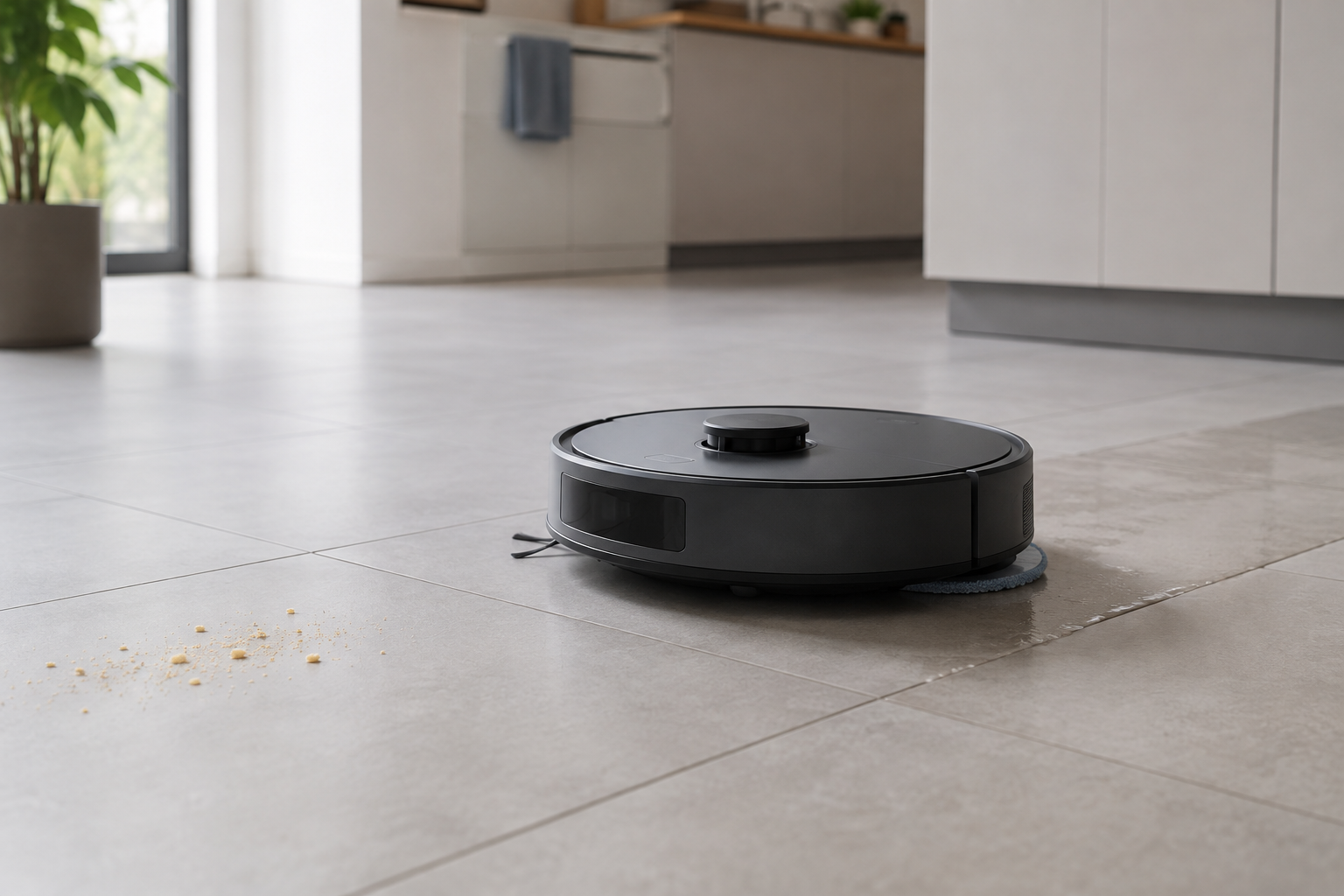
The best robot vacuum and mop for tile floors is not automatically the model with the highest advertised suction. Tile exposes a different set of problems: grit can scatter across a smooth surface, kitchen film needs controlled moisture, dirty pads can redistribute residue, and grout lines collect debris that a flat marketing specification cannot describe.
For a mostly tile home, our first choice is the Eufy Omni C28. Its roller-style mop continually presents a refreshed cleaning surface, and independent reviews support its hard-floor pickup and dried-stain performance. Choose the Roborock Qrevo S5V if the same robot must also clean carpet, or the Dreame L40 Ultra Gen 2 if baseboards and square corners are the priority.
This is a research-based comparison, not a claim that we personally tested five robots on the same tile course. Scott, BetterPickAdvisor’s consumer-electronics editor and a former engineer, compared independent test results with official product documentation and then separated supported findings from design-based judgments. See How We Research for the editorial process.
Quick picks for tile floors
| Best for | Model | Mop type | Price tier | Why this pick |
|---|---|---|---|---|
| Kitchen film and frequent sticky marks | Eufy Omni C28 | Self-refreshing roller | Mid-range | Limits how long the same dirty mop surface stays on the floor |
| Tile plus carpet or area rugs | Roborock Qrevo S5V | Dual spinning pads | Mid-range | Balances tile mopping with stronger mixed-floor capability |
| Baseboards and cabinet toe kicks | Dreame L40 Ultra Gen 2 | Extendable spinning pads | Premium | Extending brush and mop target the room perimeter |
| A second roller-mop option | Yeedi M16 Infinity | Self-refreshing roller | Mid-range | Combines roller washing with a full-service dock |
| Loose dust and crumbs | Roborock Q7 M5+ | Basic drag pad | Budget | Adds mapping and self-emptying when vacuuming matters most |
The five best robot vacuum and mop combos for tile
1. Eufy Omni C28 — best for mostly tile homes
Why it fits tile floors: The C28’s HydroJet roller continually rotates through its cleaning system, so the contact surface does not stay unchanged for an entire room. For kitchens and open-plan tile, that design directly addresses the risk of moving yesterday’s residue across today’s floor.
Evidence: Vacuum Wars’ C28 review found above-average dried-stain mopping, relatively little water left after its mopping test, strong hard-floor pickup, and effective hair resistance. WIRED’s home review also found it worked well on hard floors while being less convincing as a carpet specialist. Different protocols cannot be combined into one score, but both support the same use case.
Scott’s engineering take: The roller is not automatically “more powerful” than dual spinning pads. Its real advantage is process control: introduce water, agitate, remove soil from the active surface, and keep moving. That is the closest match in this group to the hygiene problem tile presents.
Where it loses: Tom’s Guide praised the mopping but reported less impressive corner cleaning and navigation. Homes with deep carpet or many square corners may be better served by a different balance.
Choose it if: most of your floor is tile, cooking residue and paw prints are common, and you want the dock to handle routine mop washing.
Skip it if: deep carpet cleaning, the tightest corner reach, or the smallest possible dock matters more than hard-floor washing.
Check price & availability on Amazon
2. Roborock Qrevo S5V — best for tile and carpet
Why it fits tile floors: Dual spinning mops, an extendable edge mop, adjustable water flow, and a wash-and-dry dock make the S5V a capable tile maintainer. It also lifts its mops over carpet, giving it the strongest overall case when tile is only one part of the floor plan.
Evidence: Vacuum Wars found its dried-stain mopping above the test average and its overall mopping result strong, although it used more water than average. TechGearLab found good pickup of larger hard-floor debris and useful edge coverage, but reported visible rows of fine sand left behind. Those findings are not contradictory: the S5V is a balanced cleaner, not proof that high advertised suction eliminates fine grit.
Roborock’s official documentation also lets users adjust water flow and clean along preset tile direction. Those are configurable features, not independent proof of better grout cleaning.
Scott’s engineering take: This is the lower-risk choice when one robot has to cross tile, rugs, and carpet. The tradeoff is that spinning pads keep carrying soil until the robot returns to wash them. Use room sequencing: clean lower-soil spaces before the kitchen or pet area, then send the robot back to the dock.
Where it loses: Fine sand pickup was imperfect in one independent test, water use can be generous, and obstacle avoidance trails premium machines. Pre-clear cables and small objects.
Choose it if: you need one robot for tile and carpet, want stronger edge coverage than a fixed roller, and are willing to tune water flow.
Skip it if: your home is almost entirely tile and wet-cleaning hygiene matters more than mixed-floor versatility.
Check price & availability on Amazon
3. Dreame L40 Ultra Gen 2 — best edge-cleaning hardware
Why it fits tile floors: Tile often runs under cabinet toe kicks and up to straight baseboards where round robots leave a narrow strip. The L40 Ultra Gen 2 uses an extendable side brush and extendable mop to address that geometry, while dual rotary pads and adjustable moisture target routine wet cleaning.
Evidence: Dreame’s U.S. product documentation confirms the SideReach brush, MopExtend system, moisture adjustment, mop lift, and a dock that washes and dries the pads and manages water. We did not find sufficiently broad independent comparative testing for this exact Gen 2 model to claim it out-cleans the C28 or S5V on tile.
Scott’s engineering take: The edge mechanism is a rational response to the geometry problem, so this is our hardware-led pick—not an evidence-led overall winner. An extending mop can reduce the untouched strip, but it does not guarantee that the same area receives the same pressure, dwell time, or soil removal as the center path.
Where it loses: The dock is large, the system has more moving parts and consumables, and the strongest tile-specific claims currently come from product design rather than a deep independent evidence base.
Choose it if: edge strips are your main frustration, you have room for a full dock, and you value automation.
Skip it if: you want the model with the clearest independent tile-cleaning record or prefer a simpler ownership system.
Check price & availability on Amazon
4. Yeedi M16 Infinity — roller-mop alternative
Why it fits tile floors: Like the C28, the M16 Infinity uses a roller approach that suits frequent hard-floor washing. Its station handles dust emptying, mop washing, drying, and water management, making it attractive for a large tile area that is cleaned several times per week.
Evidence: A Homes & Gardens home review reported that the M16 handled oily stains on hard flooring and reduced manual dock work. That supports a credible use case, but one home review is not enough to make it the default recommendation.
Scott’s engineering take: The M16 is here because its cleaning architecture is relevant, not because novelty deserves a higher rank. For a newer robot, service history, replacement rollers, bags, cleaning solution, app support, and return terms matter almost as much as the first mopping result.
Where it loses: It has less multi-source and long-term evidence than the two leading picks. Availability and consumable cost can also change the ownership equation.
Choose it if: you want a second roller-mop option and current local support, consumables, and return terms are acceptable.
Skip it if: you prefer the longest evidence record or do not want to depend on a newer accessory ecosystem.
Check price & availability on Amazon
5. Roborock Q7 M5+ — best budget vacuum-first pick
Why it fits tile floors: If your real problem is dust, crumbs, and hair rather than dried kitchen soil, scheduled vacuuming creates most of the value. The Q7 M5+ adds LiDAR mapping and self-emptying without requiring space or budget for a full mop-washing dock.
Evidence: TechGearLab’s Q7 M5+ review supports its coverage, mapping, app usability, and everyday hard-floor role, while also finding weak pet-hair and small-object performance. Its basic mop system does not support a claim of deep tile washing.
Scott’s engineering take: A cheaper vacuum-first robot can be the better system if you already spot-mop spills. Buying a complex wash dock to solve a dry-debris problem adds cost, footprint, and maintenance without necessarily improving the job you perform most often.
Where it loses: The mop is for light maintenance, not dried-on residue. It also asks more of the owner around pads, water, pet hair, and floor preparation.
Choose it if: you mainly want automatic pickup on open tile, already clean spills manually, and value a smaller ownership burden.
Skip it if: mopping is the primary reason you are shopping, you have heavy shedding, or clutter stays on the floor.
Check price & availability on Amazon
Our independent view: tile cleaning is a contamination-control problem
Most buying guides treat tile as an easy version of carpet and rank robots by suction. We think that misses the harder half of the job.
Once loose debris has been collected, the robot must pick up soil with water, keep that soil away from the clean side of the mop, and avoid leaving enough detergent or dirty water to create haze. The Tile Council of North America notes that soap or oily-cleaner residue can attract dirt in grout and describes effective grout cleaning as a process that includes removing dirty water, rinsing, and extracting again. A robot dock can improve routine hygiene, but it does not reproduce that full restoration process.
That leads to our Three-Layer Tile Cleaning Framework:
- Surface pickup: Does the robot collect dust, crumbs, hair, cat litter, and fine grit without scattering them or skipping the room perimeter?
- Wet-cleaning hygiene: Does the mop loosen everyday soil while limiting dirty-water transfer, excess moisture, and residue? How much manual pad and dock cleaning remains?
- Grout reality: Can the robot maintain shallow grout lines, and does the recommendation clearly admit when a scrub brush or wet extractor is still needed?
This framework is our editorial interpretation of the available evidence. It is not a laboratory score, and we do not assign synthetic decimals to tests performed in different homes with different debris and flooring.
Tile-cleaning fit matrix
| Model | Loose debris | Sticky everyday soil | Edges and corners | Mixed floors | Grout maintenance | Evidence confidence |
|---|---|---|---|---|---|---|
| Eufy Omni C28 | Strong | Strong | Fair | Good | Surface maintenance only | Medium–high |
| Roborock Qrevo S5V | Good | Strong | Good | Strong | Surface maintenance only | Medium–high |
| Dreame L40 Ultra Gen 2 | Promising | Promising | Strong hardware case | Strong on paper | Surface maintenance only | Limited |
| Yeedi M16 Infinity | Good | Promising | Fair | Good | Surface maintenance only | Medium–low |
| Roborock Q7 M5+ | Good for routine debris | Basic | Fair | Fair | Loose debris only | Medium |
“Strong,” “Good,” and “Fair” are buying-fit labels, not normalized test grades. The confidence column reflects the depth and independence of the evidence available for the exact model.
What most tile-floor buying guides get wrong
They turn advertised suction into a universal ranking
Pa is a manufacturer specification, not a cross-brand cleaning standard. A high number does not tell you whether a side brush will scatter cat litter, whether fine sand remains in shallow grout, or whether the robot covers the entire kitchen. Independent pickup evidence is more useful than the biggest number on a product page.
They call grout cleaning solved
A robot can vacuum loose material from accessible grout lines and wipe away light surface soil. Darkened or porous grout is different. It may need cleaner dwell time, mechanical agitation, rinsing, and dirty-water extraction. We would reject any buying claim that treats a robot as a replacement for that work.
They ignore where the dirty water goes
Mop motion gets attention, but soil separation matters just as much. A roller that is refreshed during the run has a plausible contamination-control advantage. Spinning pads can scrub effectively, but they depend more heavily on dock-return frequency, pad washing, route order, and user maintenance. Neither system stays hygienic if the dirty-water tank or dock tray is neglected.
They assume all tile homes have the same problem
An entryway with dry grit, a kitchen with cooking film, and a pet area with muddy paw prints do not need the same setup. Soil type is often a better decision variable than whether the tile is labeled ceramic or porcelain.
Choose by the soil you actually have
| Common problem | Prioritize | Avoid overpaying for |
|---|---|---|
| Dry dust, cereal, and crumbs | Reliable coverage, controlled side brush, self-emptying | A premium wash dock if you rarely wet-mop |
| Fine outdoor grit in an entryway | Independent fine-debris results, two-pass zone cleaning, clean brush channels | Advertised Pa alone |
| Cooking film and footprints | Refreshed mop surface, adjustable water, easy dirty-water handling | Carpet-first performance you will not use |
| Muddy paw prints | Frequent zone runs, mop washing, good object avoidance | One heavy wet run after soil has dried |
| Debris along baseboards | Edge brush and mop extension, perimeter route coverage | Center-path suction claims |
| Dark or stained grout | Manual agitation, rinsing, dirty-water extraction | Claims that a robot “deep cleans” grout |
Choose by tile type
| Your floor | What matters most | Practical guidance |
|---|---|---|
| Glossy porcelain | Streak control and a clean mop surface | Start with conservative water and inspect the floor after it dries |
| Textured ceramic | Active mopping and repeated coverage | Use a targeted second pass rather than relying on higher suction |
| Wide or recessed grout | Loose-debris pickup and realistic limits | Let the robot maintain surface soil; deep-clean stained grout manually |
| Tile plus area rugs | Mop lift and mixed-floor navigation | Confirm the exact model’s lift height and protect thick or high-pile rugs |
| Natural stone | Flooring-approved moisture and cleaner | Follow the stone or sealer manufacturer’s care instructions before wet mopping |
Can robot vacuums actually clean tile grout?
For intact glazed ceramic and porcelain tile, the robot choice changes less than the cleaning settings. Start with moderate water, inspect for haze, and increase moisture only if the floor dries cleanly. Matte and textured tile may hold fine residue more visibly and can require slower or repeated passes.
Grout is the limiting surface. Cracked, deteriorated, or highly absorbent grout should not be treated as an ordinary wet-mopping area until the floor manufacturer’s or installer’s care guidance is clear. Avoid pouring general-purpose cleaner into a robot tank unless the manufacturer explicitly approves it. Residue can affect both the floor and the machine.
No robot in this guide is presented as a grout-restoration tool. For embedded discoloration, use a grout-safe process appropriate to the installation and remove the dirty solution rather than repeatedly wiping it around.
A better setup for tile floors
- Map dry first. Let the robot build a stable map before asking it to mop around rugs, thresholds, and no-go zones.
- Vacuum before the first wet run. Water plus fine grit can create streaks or abrasive slurry. Remove the loose layer first.
- Create high-soil zones. Kitchens, entryways, and pet-feeding areas usually need more frequent cleaning than bedrooms.
- Sequence clean to dirty. Run lower-soil rooms before the kitchen or pet zone, especially with spinning pads.
- Start with conservative water. More water is not the same as more cleaning. Increase only when the floor dries without haze or wet grout.
- Use two passes strategically. A cross-pattern second pass can help textured tile and shallow grout more than simply raising suction.
- Maintain the dirty side. Empty dirty water, rinse the dock tray, remove hair from the brush, and dry washable parts on schedule.
When a robot is the wrong purchase
Do not buy a robot primarily to reverse years of grout staining, remove construction dust, clean an uneven tile installation with high lips, or handle large wet spills. A wet/dry vacuum, manual mop, grout brush, or professional cleaning process is better suited to those jobs.
A robot makes sense when the goal is frequency: collect abrasive grit before it spreads, wipe light soil before it cures, and keep open tile areas presentable with less daily labor.
How this page fits our robot-vacuum guides
This page targets tile-floor buying intent. For all-floor recommendations, use our best robot vacuum and mop combos guide. If your primary surface is wood, our hardwood-floor robot vacuum and mop comparison emphasizes dry grit pickup before low-moisture mopping. If price is the hard limit, compare robot vacuum and mop combos under $800 or robot vacuums under $500. For mop-mechanism tradeoffs, see Roborock vs Eufy for mopping. Our robot vacuum buying guide covers navigation, docks, carpet, and ownership factors.
Research notes and update policy
Sources were rechecked on September 3, 2026. We used exact-model independent reviews where available and official documentation for hardware and settings. We did not merge different publishers’ results into a synthetic score or treat manufacturer claims as comparative proof. The Dreame L40 Ultra Gen 2 and Yeedi M16 Infinity carry lower evidence confidence because fewer independent sources cover the exact current models.
We will revise the ranking when stronger exact-model testing, material firmware changes, product discontinuations, or clearly better tile-focused options change the decision. Price is deliberately excluded from the ranking logic because promotions fluctuate; confirm current availability, warranty, return terms, and consumable costs before buying.