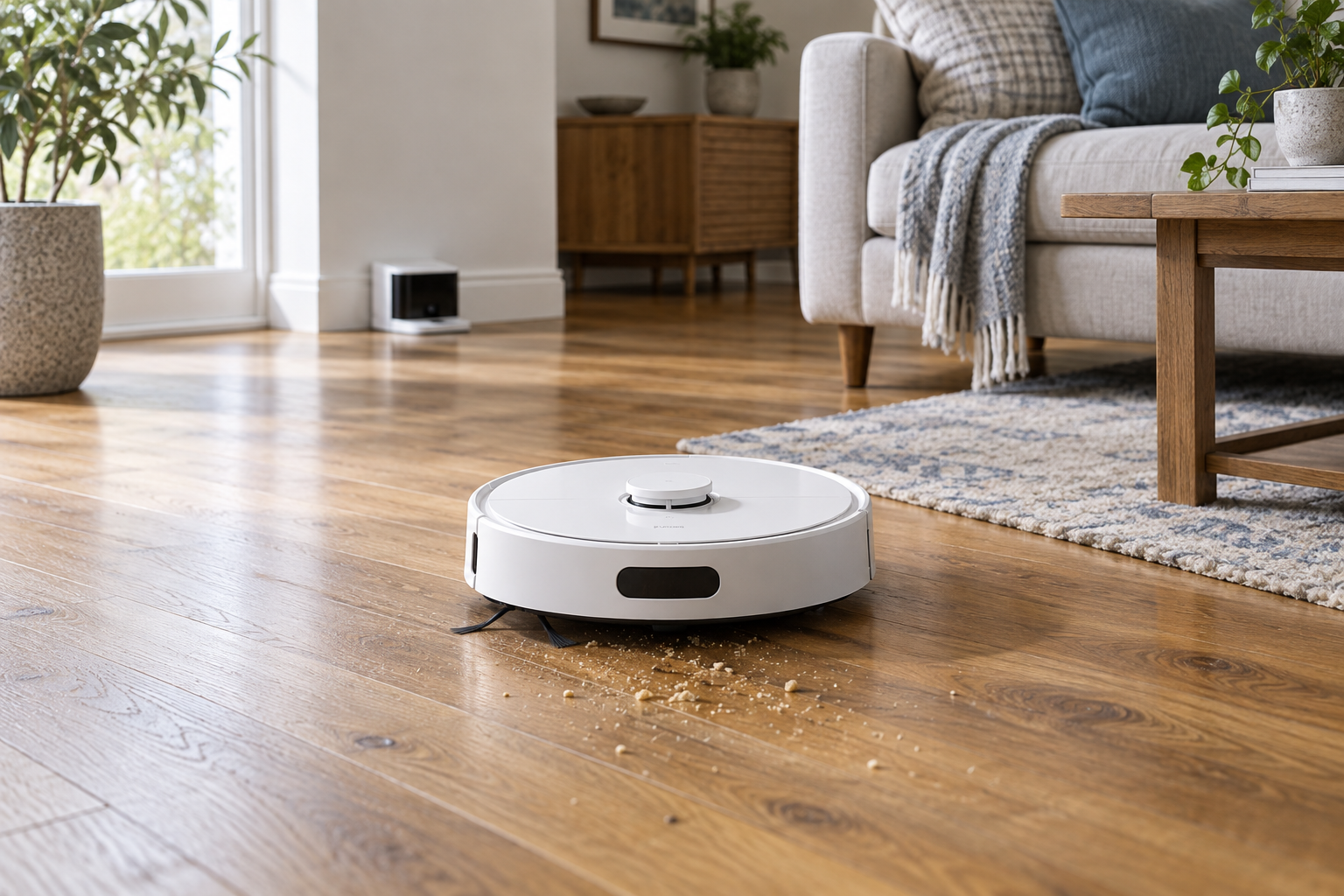
The best robot vacuum and mop for hardwood floors has to solve two different jobs in the right order. It should first remove sand, crumbs, litter, and other particles that could be dragged under a wheel or damp mop. Only then should it apply enough clean moisture to lift everyday film without leaving puddles or repeatedly carrying dirty water across the floor.
That is why the Roborock Saros 10R is our first choice. RTINGS found outstanding hard-floor pickup and strong mopping, while its low body reaches under furniture where abrasive debris often accumulates. The Eufy Omni C28 is the better value pick when conservative water use matters most. The Ecovacs Deebot X9 Pro Omni is the specialist for dried stains, but its dry pickup is not as complete near baseboards and seams.
This is a research-based buying comparison, not a claim that we personally tested all five robots. Scott, BetterPickAdvisor’s consumer-electronics editor and a former engineer, compared current independent test results with U.S. manufacturer documentation. We kept measurements inside their original test protocols rather than blending unlike data into a made-up score. See How We Research for our editorial process.
Hardwood safety first: Wet-mop only wood that its manufacturer identifies as suitable for damp cleaning. The National Wood Flooring Association advises against wet and steam mops because excessive moisture can damage the finish or wood; a damp, near-dry method may be acceptable. If your boards are unsealed, waxed, damaged, or have open seams, use vacuum-only mode and follow the floor maker’s instructions.
Quick picks for hardwood floors
| Best for | Model | Why it fits hardwood | Main limitation |
|---|---|---|---|
| Best overall | Roborock Saros 10R | Excellent dry pickup, strong mopping, low profile, and flexible floor settings | Premium price; performance depends on the right route settings |
| Best value with low residual moisture | Eufy Omni C28 | Roller separates dirty water and left very little moisture in one controlled test | Can scatter some debris near edges; middling obstacle avoidance |
| Best for dried stains | Ecovacs Deebot X9 Pro Omni | Strong roller-mop stain removal plus vacuum-first-then-mop mode | Weaker pickup at baseboards and in seams than the Saros 10R |
| Best value for hardwood and rugs | Roborock Qrevo S5V | Good debris pickup, capable spinning mops, and useful mop lift | Left more water than average in one test |
| Best edge-cleaning hardware | Dreame L40 Ultra Gen 2 | Extending side brush and mop address perimeter coverage | Exact-model independent testing remains limited |
Hardwood cleaning performance matrix
This matrix is a decision map, not a synthetic scorecard. “Strong” means an independent source directly tested the relevant behavior. “Design support” means the hardware or setting is confirmed by the manufacturer but lacks enough exact-model comparative evidence for us to call it proven.
| Model | Dry debris before mopping | Wet-cleaning evidence | Moisture control | Rugs and transitions | Evidence boundary |
|---|---|---|---|---|---|
| Roborock Saros 10R | Strong: near-complete fine, medium, and large hard-floor pickup in RTINGS testing | Strong: effective spinning-pad stain cleaning | Adjustable water; no public residual-water result used here | Mop lift or removal; strong threshold hardware | Deep Clean and extra passes materially improve dry pickup |
| Eufy Omni C28 | Good: handled hard-floor debris well, with some edge scatter | Strong: above-average dried-stain result in Vacuum Wars testing | Strong: 0.25 g left in that protocol versus a 1.07 g test average | 10.8 mm mop lift; verify against your rug pile | One detailed lab is the main evidence source |
| Ecovacs X9 Pro Omni | Good in open areas: weaker at baseboards and cracks | Strong: impressive stain removal in RTINGS and a favorable hardwood observation from Good Housekeeping | 50 manufacturer-listed water levels; Good Housekeeping reported no overly wet hardwood | 10 mm lift; low thresholds and rug tassels can cause trouble | AI settings can mistakenly avoid larger debris piles |
| Roborock Qrevo S5V | Good: all-size pickup with little scatter in Vacuum Wars testing | Strong: above-average dried-stain result | Caution: 1.25 g left versus a 1.01 g test average | 10 mm mop lift; strong mixed-floor value | Obstacle avoidance is a larger compromise |
| Dreame L40 Ultra Gen 2 | Design support: rubber brush and high advertised suction | Design support: dual spinning mops | App-adjustable moisture | 10.5 mm mop lift and 2 cm claimed threshold crossing | Comparative evidence for this exact generation is limited |
The numbers above stay attached to the source that produced them. A gram result from Vacuum Wars is not directly comparable with a visual observation from another publication, and manufacturer specifications are not treated as test results.
The five best robot vacuum and mop combos for hardwood
1. Roborock Saros 10R — best overall for hardwood
Why it ranks here: Hardwood favors a robot that is excellent at the dry stage, not merely competent. In RTINGS’ current Saros 10R test, the robot picked up nearly all fine, medium, and large debris on hard flooring and cleaned wall edges and corners very well. Its twin spinning mops also performed strongly on stains, and the low 3.14-inch body can reach beneath furniture where fine grit is easy to miss.
Dry-stage evidence: RTINGS also found an important setting dependency: hard-floor pickup became much worse when Deep Clean behavior was disabled. That makes the app configuration part of the product’s cleaning performance. We would run a vacuum-only Deep Clean pass in grit-heavy entryways before scheduling a wet pass.
Wet-stage evidence: The mops can extend toward edges, water flow is adjustable, and the app offers Deep and Deep+ mop routes. Roborock also provides a “clean along floor direction” option, which is a sensible route choice for long wood planks because it reduces repeated cross-grain turns. That setting is a control benefit, not proof that it prevents scratches.
Scott’s engineering take: The Saros 10R wins because its weakest link is smaller. The X9 may scrub a dried mark more aggressively, but a hardwood robot must first remove the particles that a wet system could drag. Strong dry pickup plus a competent, configurable mop is the safer overall balance.
Where it loses: It is expensive, its carpet pet-hair pickup is weak, and automatic extra passes can consume more battery. RTINGS tested its best stain behavior with extreme water and Deep+ routing; that is not the setting we would use first on wood. Start low and increase moisture only if the floor manufacturer permits it.
Choose it if: most of your home is hard flooring, low furniture hides dust, and you want premium navigation and dock automation.
Skip it if: you mainly need carpet pet-hair pickup, your floor plan is simple enough that a midrange robot can cover it, or you will not use the app to tune separate dry and wet routines.
Check price & availability on Amazon
2. Eufy Omni C28 — best value with low residual moisture
Why it ranks here: The C28 has the clearest value case for buyers worried about both dirty-water transfer and a floor staying wet. Its HydroJet roller receives fresh water while dirty water is collected separately, so the active cleaning surface is refreshed during the run rather than waiting for a dock visit.
Dry-stage evidence: Vacuum Wars’ C28 testing found capable pickup across hard floors and carpet, plus above-average crevice cleaning. The lab did notice a small amount of debris scattering near hard-floor edges, so it is not as complete a dry cleaner as the Saros 10R.
Wet-stage evidence: In the same protocol, the C28 scored above the category average on dried stains and left 0.25 grams of residual water compared with the test average of 1.07 grams. We are not converting those values into our own rating. The useful conclusion is narrower: among the models with published evidence we reviewed, the C28 combines effective agitation with unusually restrained residual moisture.
Scott’s engineering take: A roller mop’s real advantage is not that it is automatically “stronger.” It creates a more controlled fluid path: add clean water, agitate, scrape soil from the roller, and store the dirty water. That process is especially relevant to hardwood, where soaking the floor to compensate for a dirty pad is the wrong tradeoff.
Where it loses: Obstacle avoidance was below average in Vacuum Wars testing, the body is relatively tall, and some edge debris scattered. Its dock uses room-temperature water to wash the roller, although it dries the mop with warm air.
Choose it if: you want frequent light mopping on properly sealed hardwood, have kitchen film or footprints, and prefer a midrange price to a flagship navigation system.
Skip it if: cords and small toys are commonly left on the floor, very low furniture is a major cleaning zone, or complete baseboard pickup is the deciding factor.
Check price & availability on Amazon
3. Ecovacs Deebot X9 Pro Omni — best for dried stains
Why it ranks here: The X9 is the wet-cleaning specialist in this group. Its roller is continuously refreshed, and both RTINGS and Good Housekeeping found convincing stain performance. Ecovacs also provides a vacuum-first-then-mop mode and 50 water levels, two controls that make more sense for hardwood than a single aggressive all-in-one preset.
Dry-stage evidence: RTINGS’ X9 Pro Omni review found good everyday pickup in open hard-floor areas and limited debris scatter, but weaker results along baseboards and in cracks. It also found that AI features could mistake a larger debris pile for an obstacle and skip it. For visible crumbs or litter, we would disable the behavior that causes avoidance and inspect the first run.
Wet-stage evidence: RTINGS found excellent dried-stain removal. Good Housekeeping’s robot-mop testing selected the X9 as its hardwood pick and reported that it did not leave the tested hardwood overly wet. Ecovacs confirms that the roller receives fresh water while a scraper removes wastewater, but its pressure, airflow, and stain-detection percentages remain manufacturer claims rather than cross-brand proof.
Scott’s engineering take: We would choose the X9 for recurring food film and dried footprints, not for sandy entryways. Its strengths sit mostly in Stage 2 of the job. If Stage 1 leaves particles near seams or baseboards, the owner still needs a second vacuum pass or occasional manual edge cleaning.
Where it loses: It does not match the Saros 10R’s dry hard-floor pickup, the dock and consumables add ownership cost, and RTINGS found high ongoing maintenance. Thick rugs, tassels, and low transitions can also cause trouble.
Choose it if: your floor is properly sealed, dried marks are the main frustration, and you will use separate vacuum-first and mop routines.
Skip it if: your biggest problem is fine grit along wall edges, you want the lowest-maintenance system, or your rugs have long pile or fringe.
Check price & availability on Amazon
4. Roborock Qrevo S5V — best value for hardwood and rugs
Why it ranks here: The S5V is the practical mixed-floor pick. It has good all-size debris pickup, spinning mops that lift 10 mm over detected carpet, an extending edge mop, and a dock that empties dust and washes and dries the pads. It costs less than the flagship picks when discounted.
Dry-stage evidence: Vacuum Wars’ Qrevo S5V review found that it picked up debris of different sizes on hard floors and carpet without much scattering. Hair resistance was also strong. That makes it a credible first-stage cleaner for homes where hardwood connects directly to rugs or carpeted rooms.
Wet-stage evidence: The S5V performed well on dried stains in the same test, but it left 1.25 grams of water versus a 1.01-gram test average. That is not evidence that it will damage a floor; it is evidence that this is not the model to run blindly at a high water setting on moisture-sensitive wood.
Scott’s engineering take: The S5V is a configuration-sensitive value pick. Set hardwood rooms to low water, schedule vacuuming before mopping when grit is visible, and use carpet-first routing or no-mop zones for rugs. Its strong stain result should not be used as permission to maximize water.
Where it loses: Obstacle avoidance is a major compromise, and the dock does not wash pads with heated water. The mop can lift over low-pile rugs, but 10 mm is not a guarantee for thick pile or fringed edges.
Choose it if: your home mixes sealed hardwood with low-pile rugs or carpet and you want Roborock’s app and a full-service dock without flagship pricing.
Skip it if: you want the lowest measured residual moisture, your floor is often cluttered, or your rugs are thick enough that lifted pads may still touch.
Check price & availability on Amazon
5. Dreame L40 Ultra Gen 2 — best edge-cleaning hardware
Why it ranks here: Round robots often leave a strip beside baseboards, cabinet toe kicks, and square corners. The L40 Ultra Gen 2 uses an extendable side brush and an extendable spinning mop to reduce that geometric blind spot. Its rubber main brush is also straightforward to inspect for trapped grit before a wet run.
Evidence: Dreame’s U.S. product documentation confirms the extending hardware, 10.5 mm mop lift, app-adjustable moisture, rubber brush, hot-water pad washing, and hot-air drying. We did not find enough independent comparative testing for this exact Gen 2 model to claim it out-cleans the first four picks on hardwood.
Scott’s engineering take: This is a hardware-led recommendation with lower evidence confidence. The mechanism plausibly improves reach, but extending a brush or pad does not guarantee complete particle removal, equal pressure, or equal water recovery at the perimeter. Buyers should treat the first few edge runs as validation, not assume the feature name settles the result.
Where it loses: Its position relies more heavily on verified design than independent outcomes. The dock is large, the system contains more moving parts, and replacement bags, pads, brushes, and approved solution add recurring cost.
Choose it if: edge strips are your main complaint, your floor plan mixes hardwood and low-pile rugs, and you have room for a full dock.
Skip it if: you want the most independently proven hard-floor performer or a simpler machine with fewer consumables.
Check price & availability on Amazon
Our independent view: hardwood cleaning is a three-stage system
Stage 1: remove abrasive dry debris
Suction in pascals does not tell you whether a side brush scatters rice, whether fine grit remains beside a wall, or whether the route gives a dirty area a second pass. For hardwood, those outcomes matter because particles left behind can be dragged beneath wheels or a damp cleaning surface.
This is why the Saros 10R leads even though another robot may post a stronger stain result. It has direct evidence for the first job. The C28 and S5V are credible alternatives, while the X9 needs more attention at edges and seams.
Stage 2: add controlled clean moisture
A robot should not compensate for incomplete vacuuming by adding more water. We favor systems that let the owner separate the stages, set room-specific moisture, refresh the cleaning surface, and return to wash before carrying high-soil residue into a lower-soil room.
Roller mops offer a useful dirty-water path. Spinning pads can still be effective when they are washed frequently and run at an appropriate water level. The design label is less important than residual moisture, pad hygiene, and the owner’s route settings.
Stage 3: protect rugs, transitions, and the dock area
A hardwood home is rarely one uninterrupted surface. Area rugs, runners, transition strips, and the dock introduce failure points. Mop lift must exceed the actual rug pile; fringe may still catch; and a dock placed on wood should sit level with no leaks or wet pads left underneath it.
Run the first complete route while you are home. Confirm that the robot recognizes every rug, clears each threshold, returns without dripping, and leaves no standing water around the dock.
Choose by the mess you actually have
| Your recurring mess | First priority | Best starting point | Why |
|---|---|---|---|
| Entryway sand, crumbs, cat litter | Dry pickup and low scatter | Roborock Saros 10R | Strongest direct hard-floor pickup evidence in this group |
| Footprints and light kitchen film | Low residual moisture and clean-water delivery | Eufy Omni C28 | Roller refresh plus restrained water result in testing |
| Dried food marks | Stain agitation and separate cleaning stages | Ecovacs X9 Pro Omni | Strong stain evidence and vacuum-first-then-mop mode |
| Hardwood connected to rugs or carpet | Mop lift and mixed-floor routing | Roborock Qrevo S5V | Balanced vacuuming, mopping, and value |
| Dust lines along baseboards | Edge-reaching hardware | Dreame L40 Ultra Gen 2 | Extending brush and mop target the perimeter, with lower evidence confidence |
| Mostly dust with occasional manual damp mopping | Reliable vacuuming without a water system | Consider vacuum-only | Avoid paying for dock and mop maintenance you will not use |
For shedding pets, brush design and carpet hair pickup add another decision layer; see our robot vacuum and mop guide for pet hair. If your hard surface is ceramic or porcelain instead, our tile-floor robot vacuum and mop comparison focuses more heavily on kitchen residue, grout limits, and dirty-water transfer.
What most hardwood robot-vacuum rankings miss
They rank the wet stage without testing the dry stage
A powerful mop can make the floor look cleaner while still dragging the particles the vacuum missed. The correct sequence is not a minor setup tip; it is part of product selection. A robot with incomplete hard-floor pickup needs more supervision before wet cleaning.
They treat maximum water as maximum cleaning
Water can improve stain removal, but hardwood does not reward the wettest possible setting. The useful question is whether the robot removes the everyday soil at the lowest practical moisture level and whether that moisture dries promptly.
They call a mop-lift number universal rug protection
A 10 mm or 10.8 mm lift describes the mechanism, not the clearance between a wet pad and every rug. Pile height, compression, uneven edges, and fringe all change the result. No-mop zones remain the safer choice when the first supervised run is uncertain.
They hide weak evidence behind a precise score
We do not assign invented percentages to dry pickup, mopping, navigation, and maintenance. The performance matrix tells you which claims have direct independent support and which are design-based judgments. That distinction is more useful than a decimal rating whose inputs cannot be audited.
Can a robot vacuum scratch hardwood?
Normal rubber wheels and soft brushes are not supposed to scratch an intact finish. The more realistic risk is contamination: a sharp particle becomes trapped in a wheel tread, brush, caster, or damp mop and is carried across the surface.
Before the first run, inspect the floor for screws, small stones, hard pet-litter fragments, and damaged boards. Then check the caster and main brush regularly. If grit is visible, run vacuum-only first and inspect the bin and wheels before enabling the mop.
A safer first-week setup for sealed hardwood
- Confirm the finish and care instructions. Do not infer that every surface sold as “wood” accepts wet cleaning.
- Map without mopping. Identify rugs, fringes, thresholds, floor vents, and places where the robot can trap debris.
- Run vacuum-only. Use normal or deep routing until loose particles are no longer visible.
- Start with low water in one room. Check seams, edges, and drying time immediately after the pass.
- Separate high-soil rooms. Clean an entryway or kitchen after lower-soil rooms, or send the robot to wash before continuing.
- Inspect the dock area. Keep the dock level and dry, empty dirty water promptly, and never let a wet pad sit directly on the floor outside the station.
The correct setting is floor-specific. A factory-finished sealed plank and an older site-finished floor with open seams should not receive the same routine.
When a vacuum-only robot is the better purchase
A mop dock is not automatically an upgrade. Choose vacuum-only if the flooring manufacturer prohibits damp cleaning, if the boards are unsealed or damaged, or if your main problem is dry dust and pet hair. A simpler robot plus occasional manufacturer-approved manual cleaning can be safer and cheaper than maintaining tanks, wastewater lines, pads, solution, and a large dock.
If you are still deciding which features your home needs, start with our complete robot vacuum buying guide. For a wider mixed-floor shortlist, compare our best robot vacuum and mop combos. Those pages answer broader intents; this page is specifically for shoppers deciding how a combined robot should handle hardwood.
Research notes and update policy
Scott reviewed the current U.S. SERP and product evidence on September 11, 2026. The main independent sources were RTINGS for repeatable hard-floor, stain, obstacle, and clearance testing; Vacuum Wars for C28 and Qrevo S5V debris, mop, water, hair, and navigation protocols; and Good Housekeeping for a separate hardwood mopping observation. Official Roborock, Eufy, Ecovacs, and Dreame pages were used to confirm settings, dimensions, dock functions, mop lift, and cleaning modes.
We did not combine results from different protocols into a BetterPickAdvisor performance score. Manufacturer suction, pressure, water-temperature, and runtime figures are treated as specifications or claims, not proof of cross-brand superiority. The page will be substantively updated when an exact model changes, stronger independent evidence alters a recommendation, or U.S. availability makes a pick impractical.
Sources checked: RTINGS Saros 10R review, RTINGS X9 Pro Omni review, Vacuum Wars Eufy C28 review, Vacuum Wars Qrevo S5V review, Good Housekeeping robot-mop testing, NWFA maintenance guidance, Roborock Saros 10R documentation, Eufy C28 documentation, Ecovacs X9 Pro Omni documentation, and Dreame L40 Ultra Gen 2 documentation.